Tried this recipe? We love your feedback.Please click on the stars in the recipe card below
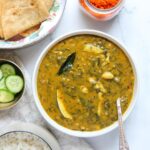
Alu Chi Bhaji
Alu Chi Bhaji is a tangy, lightly sweet Maharashtrian curry of colocasia leaves, peanuts and chana dal, finished with a garlic tadka. My mom's recipe.
Servings: 6
Recipe Video
Ingredients
For the bhaji
- 8 medium colocasia Patra leaves, about 0.4 lb, thinly sliced (4 cups)
- 6 colocasia stems Peeled and thinly sliced (1 cup)
- 1 green chili Finely chopped
- 2 teaspoons oil
- 3½ cups hot water Divided, to cook the leaves, and then to thin the curry
- 1 tablespoon coriander powder
- 3 teaspoons kosher salt Divided
Ingredients to soak
Tamarind Besan Mixture
Tadka
- 1 tablespoon oil
- 1 teaspoon mustard seeds
- ⅛ teaspoon hing asafoetida
- 4 garlic cloves finely diced (about 1 tablespoon)
- 20 curry leaves
- ¼ teaspoon turmeric
- 1 teaspoon Kashmiri red chili powder
Instructions
- Soak the peanuts, chana dal, and coconut slices in hot water for 20 minutes.
- Rinse the colocasia leaves and pat them dry. Cut off the stems and reserve 6 for the curry.
- Shave off the thick veins and ribs on the back of each leaf and discard them. Stack 4 leaves, roll them tightly, and slice thinly. Repeat with the remaining leaves.
- Peel the reserved stems by hand, then slice thinly and dice small.
- Heat 2 teaspoons of oil in a medium saucepan over medium heat. Add the sliced leaves, stems, and green chili. Sauté until the leaves wilt and shrink.
- Add half the salt, mix well, cover, and cook for 2 to 3 minutes on medium heat.
- Add half of the hot water and mix well. Cover and cook on low-medium heat for 10 minutes. Whisk everything together.
- Drain the soaked peanuts, chana dal and coconut and add them to the pan. Cover and cook for 5 minutes on low-medium heat.
- Uncover and bring to a boil. Check that the chana dal is cooked by pressing a piece between your fingers; it should break easily.
- Add the coriander powder and remaining salt.
- In a small bowl, mix the tamarind, jaggery, and besan with water until smooth. Add it to the pan and whisk to make it smooth.
- Add the remaining hot water to thin out the curry. Cook on medium heat until it comes to a gentle boil, stirring occasionally.
- For the tadka, heat oil in a small pan over medium heat. Add the mustard seeds. Once they pop, lower the heat and add the hing and garlic. Add the curry leaves, turmeric, and red chili powder, and cook for about a minute, until the garlic turns golden and aromatic. Turn off the heat.
- Pour the tadka into the curry and mix well. Cook uncovered on medium heat for 2 to 3 minutes, until the curry bubbles rapidly. Turn off the heat.
Thin ribbons cook faster, soften completely, and give the bhaji its signature silky texture.
A hand whisk breaks up the leaves slightly.
Tried this recipe?Share your photo and tag @ministry_of_curry or tag #ministryofcurry
