

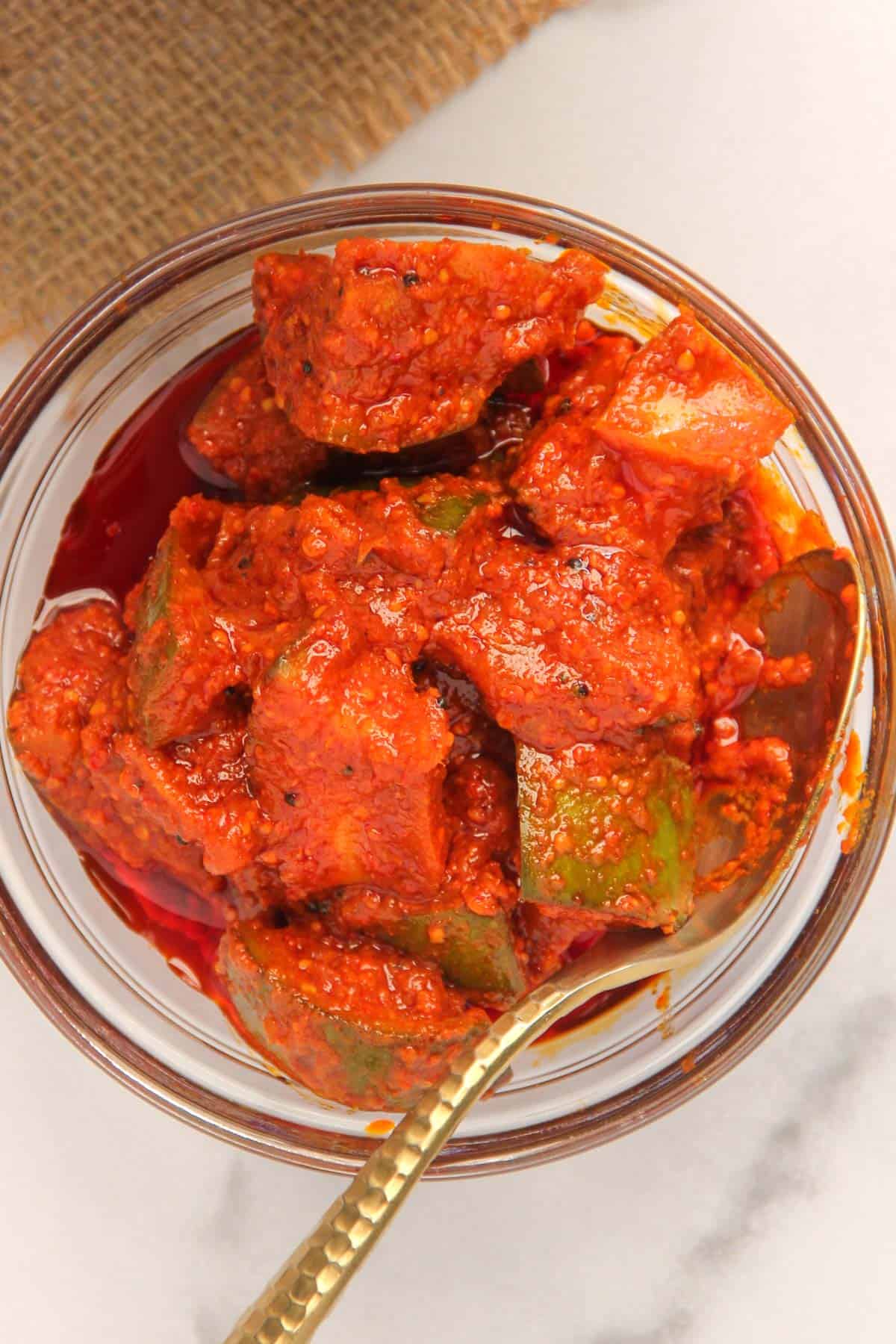
Some recipes are so deeply rooted in Indian home cooking that they feel less like cooking and more like a ritual. For my family, homemade Mango Pickle is exactly that. Every summer in Maharashtra, my mom would make her beloved Ambat Goad Lonche, a sweet, sour, and spiced mango pickle that filled our home with the most incredible aroma and lasted us well beyond the mango season. This is her recipe exactly as she made it, and every jar I make today brings me right back to those summers.

Want to Save This Recipe?
Enter your email & I'll send it to your inbox. Plus, get great new recipes from me every week!
By submitting this form, you consent to receive emails from Minstry of Curry
Aam Ka Achar is one of the most beloved traditional Indian side dishes and for very good reason. A spoonful of this intensely flavored, tangy, spiced pickle transforms the simplest meal into something truly special. Dal rice, curd rice, khichdi, and a humble paratha all taste better with a little mango pickle on the side. It also holds a proud place on elaborate festival thalis where it adds that essential pop of bold flavor that ties the whole spread together.
Family Heirloom Recipe
In India, summer was always pickle-making season, and in our home, it was a full family affair. My mom would buy unripe green mangoes in bulk from the market, soak them in water, and then expertly slice them using a traditional cutter called Adkitta. The cut mango pieces would be rubbed with turmeric and salt and left to drain and dry before being combined with the vibrant red pickle masala and fragrant oil that would carry and preserve all those bold flavors for months to come.
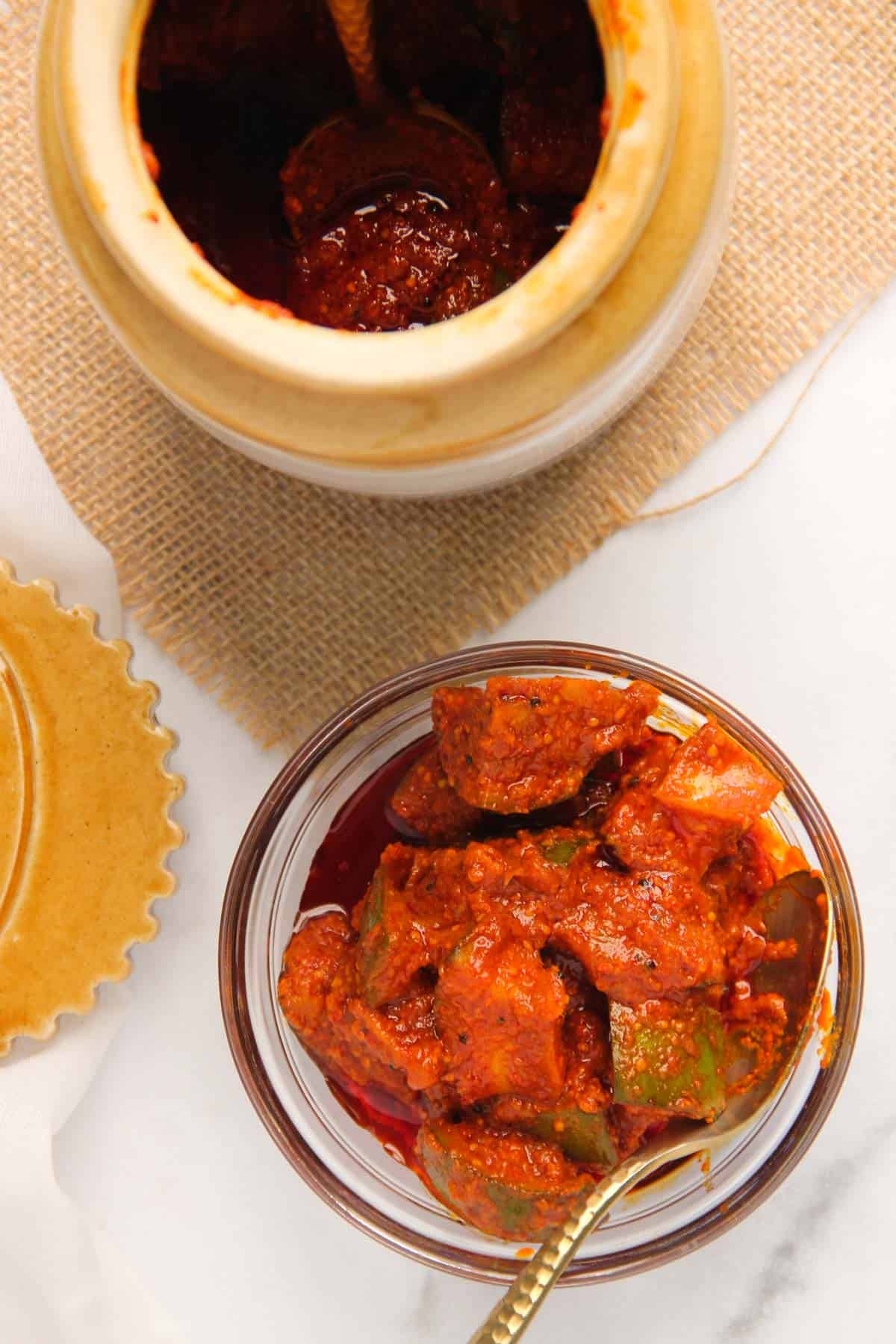
The finished pickle was carefully packed into beautiful brown ceramic jars that my mom kept cleaned and dried specifically for this purpose. There was something almost ceremonial about the whole process, and the reward was worth every step - a bold, deeply flavored pickle that lasted all year long.
Unlike quick pickles that are ready in minutes, this authentic Indian mango pickle is a labor of love that requires time and patience. The overnight salt and turmeric soak, the careful drying, the slow development of flavor over several days- each step serves a very specific purpose and contributes to that deeply bold, complex flavor that no store-bought pickle can come close to replicating. It is the kind of recipe where the process itself is part of the joy.
Mom's Tips
- Dry the Mangoes Thoroughly - This is the single most important step for a long lasting pickle and one my mom never skipped. After draining the turmeric salt water, spreading the mango pieces on a kitchen towel and allowing them to dry completely for a full 8 hours removes every last bit of excess moisture. The drier the mango pieces going into the jar, the longer and better the pickle keeps. When done properly this pickle can stay good at room temperature for a full year.
- Adjust the Masala to Your Taste - This recipe gives you a beautifully balanced pickle with just the right amount of masala coating each piece. But if you love a more generously spiced pickle to enjoy with rice, khichdi or chapatis, simply add the entire package of pickle masala along with an extra quarter cup of oil. The additional oil is important here, more masala needs more oil to carry and preserve those bold flavors properly.
Ingredient Notes
- Unripe Green Mangoes - Use firm, unripe green mangoes with no yellow coloring at all; the greener and harder, the better. You can find them at Indian grocery stores during spring and early summer when they are at their peak.
- Turmeric - Turmeric in the initial salt soak firms up the mango pieces, giving the pickle that satisfying firm bite even after months of storage. It also has natural antibacterial properties that contribute to the long shelf life of the pickle. Do not skip this step and do not rush it; the overnight soak is what makes the difference.
- Pickle Masala - The pickle masala is the heart of the flavor in this recipe. My mom always usedK-Pra pickle masala, which gives a beautifully balanced blend of split mustard seeds, chili, and spices. Deep pickle masala or Rani pickle masala are both excellent alternatives available at Indian grocery stores and on Amazon. If you want to make your own homemade pickle masala, I have included the recipe in the notes section of the recipe card below.
- Jaggery - A small amount of jaggery is what gives my mom's version its signature sweet note that perfectly balances the intense sourness of the green mango and the heat of the spices. This is the Ambat Goad (sweet and sour) element that makes this Maharashtrian pickle so distinctive and so addictive.
- Oil - Oil is not just a flavor carrier in this recipe; it is the primary preservative that allows the pickle to last for up to a year. Any neutral oil works beautifully. For a more authentic flavor, try sesame oil or mustard oil, both of which are traditional choices in Indian pickling and add a wonderful depth. Whatever oil you use, make sure you use enough; a thin layer of oil sitting on top of the packed pickle jars is what protects the pickle during storage.

How to Make Mango Pickle
Sharing detailed photos so you know the process and how the pickle should look at each step:


★ Tried this recipe? I'd love to hear how it turned out! Leave a comment and let me know, or snap a quick pic and upload it-I love seeing your creations. If you're on Instagram, tag @ministry_of_curry so I can check it out. Your feedback means so much to me and makes all the time I spend perfecting each recipe totally worth it. Thank you!
Recipe
Homemade Mango Pickle (Indian Aam Ka Achar)
Equipment
Recipe Video
Ingredients
- 1½ lbs raw mangoes 2 medium mangoes, rinsed and dried well
- 1 tablespoon sea salt
- 1 teaspoon ground turmeric
- ½ cup oil
- 1 teaspoon mustard seeds
- ¼ teaspoon hing {asafetida}
- ½ cup jaggery shredded
- 80 grams pickle masala
- 3 teaspoons kosher salt
Instructions
- Using a sharp chef's knife cut mangoes into half. Then cut each half into 1-inch cubes along with the hard inside pit. Discard the innermost seed that will fall out.
- Add the cut mango pieces to a bowl and sprinkle salt and turmeric. Mix well and keep covered overnight. This helps remove some sourness from the mango pieces and helps release the excess moisture. Turmeric makes the pieces firm preventing the mango pieces from getting soft so that the pickle has a nice bite to it. The antibacterial turmeric also helps with extend the shelf life of the pickle
- The next morning, pour the mango pieces into a strainer to drain out all of the liquids.
- Keep the drained mangoes in a single layer on an old kitchen towel for 8 hours to dry out the excess liquids. This step will further increase the shelf life. Just remember to use an old kitchen towel as it will get stained from the turmeric and you will most probably end up discarding the towel.
- Heat oil in a medium skillet. Add mustard seeds and allow them to pop. Add asafetida. Turn the heat off and allow the oil to cool completely. Add jaggery to the oil and give a quick stir.
- Add mango pieces to the oil along with the pickle masala and salt. Mix well.
- Using disposable gloves add the pickles to a clean and dry glass jar, pressing the pickle firmly inside the jar.
- Cover the jar with a cheesecloth or paper towel and secure it with a rubber band. Keep overnight. Keep in an airy spot. By morning some of the excess oil will start to rise to the top. Mix well again and keep covered with the cheesecloth. Repeat this step for 3 to 4 days
- Pickle will be ready to enjoy in 3 days. You can then close the lid and keep it in a cool dry place. You can also refrigetare the jar if you like.
- If you like more pickle masala to enjoy with rice, khichdi or chapatis add the entire package of pickle masala and an additional ¼ cup of oil.
Notes
- Drying mango after draining out the turmeric salt water will increase the shelf life of the pickle.
- If you like more pickle masala to enjoy with rice, khichdi or chapatis add the entire package of pickle masala and an additional ¼ cup of oil.
- Use a clean dry spoon to take out the mango pickle. Every time you take out pickles press the mango pieces down so there is a layer of oil on top that will prevent the pickle from being spoiled.
- Homemade Pickle Masala - Don't have premade pickle masala, make it at home with these easy steps. To make pickle masala lightly roast ⅓ cup of split yellow mustard seeds and 1 teaspoon fenugreek seeds. Cool down and grind to a powder. Add ⅓ cup of mild Kashmiri red chili powder or use less if using hotter chili powder.
- Mixed Vegetable Pickle - Here is the biggest tip from Mom. You can use this recipe to make pickles of any vegetable such as green chili, carrot, lemon, gooseberry, or cauliflower. You can also use a mix of all of these vegetables and follow the same steps. This will stay well refrigerated for up to a month.
- Instant Mango Pickle - Don't have sharp knives to cut the hard unripe mangoes? You can peel mangoes, discarding the peel. Then shred the mango and apply turmeric and salt. Squeeze out all the liquids and skip the drying on the kitchen towel step. Follow the remaining recipe. This Instant mango pickle can be enjoyed right away. Refrigerate for up to 1 month. You can also make this type of Instant shredded pickle with carrots and turmeric.
- Skip Sweetener - Although jaggery adds a hint of sweet flavor but can be optional if you are watching your sugar.
Aparajita says
Hi
Lovely recipe.
Thank you for.the share
Can you tell me.the brand of pickle masala used ?
Archana says
K-Pra brand pickle masala.
Joe says
May be I missed it in the description, but why do you leave pieces of the mango stone in the chopped fruit?
Archana Mundhe says
That is a traditional way of making pickles as it also helps keep the mango pieces firm and have a nice bite. The piece of pit is discarded when you eat.
Kiran Harjani says
Simplest pickle recipe ever !! And so yummy !!
Archana Mundhe says
Thank you!!